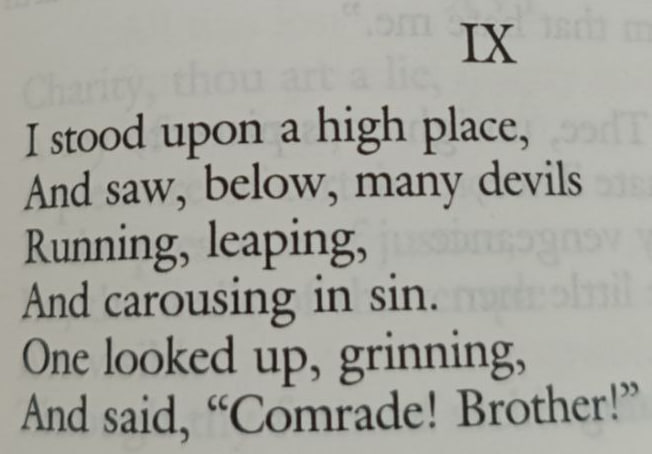
Allowables by Nikki Giovanni
I killed a spider
Not a murderous brown recluse
Nor even a black widow
And if the truth were told this
Was only a small
Sort of papery spider
Who should have run
When I picked up the book
But she didn’t
And she scared me
And I smashed her
ㅤ
I don’t think
I’m allowed
ㅤ
To kill something
ㅤ
Because I am
ㅤ
Frightened
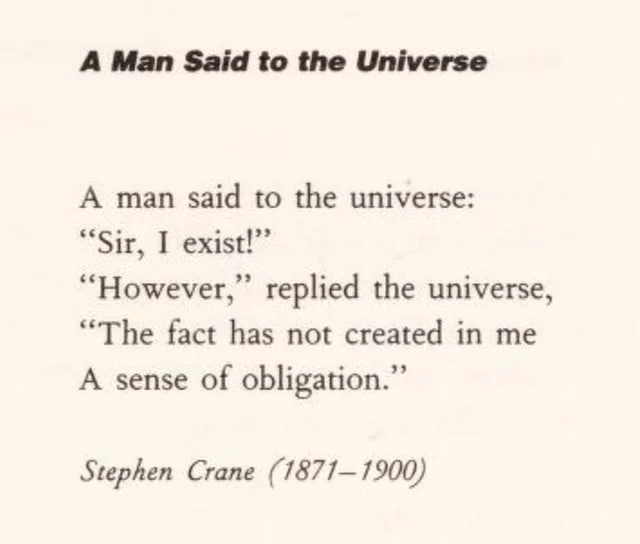
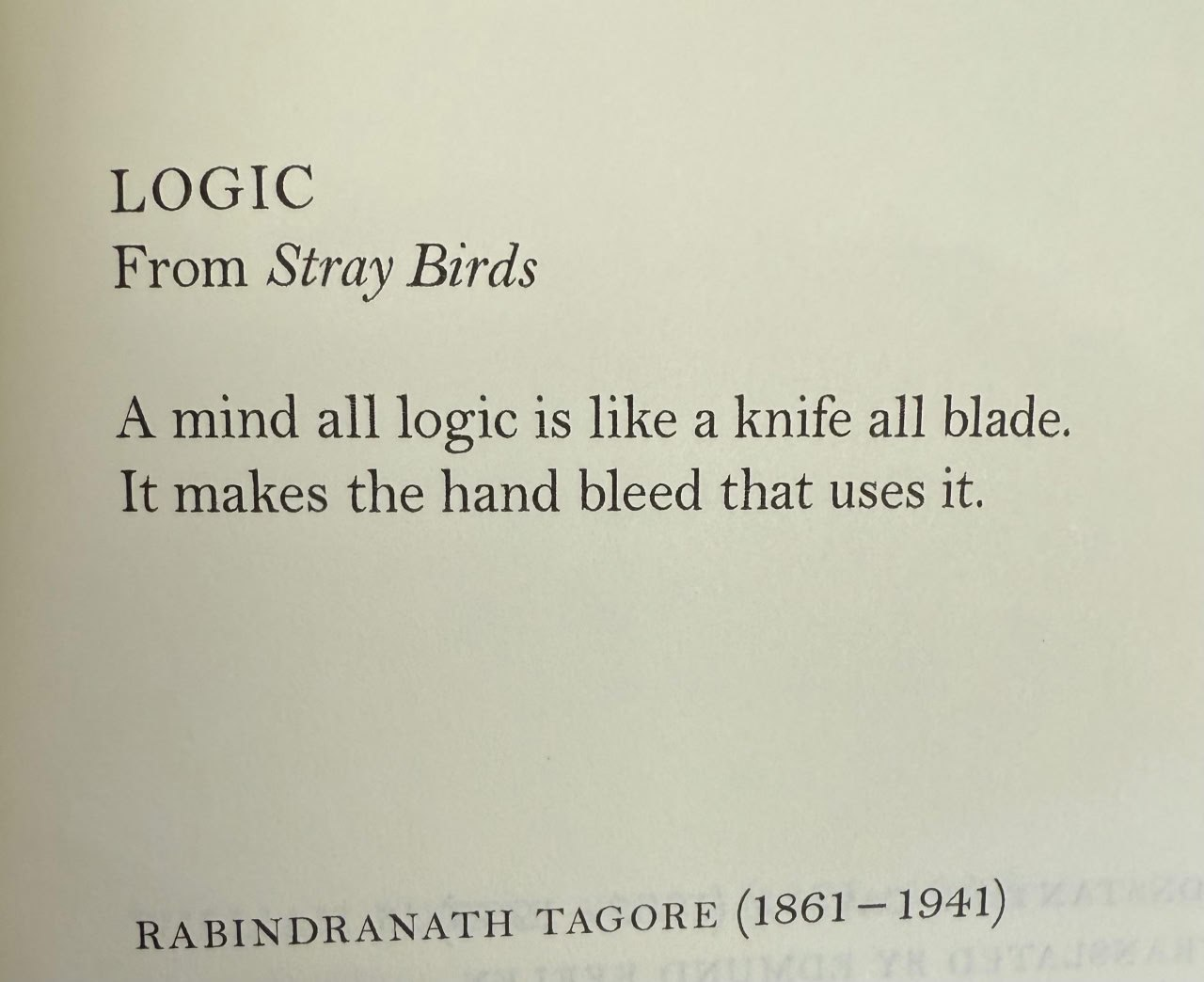
Her Hair by an anonymous poet of ancient India
When the lovely woman had finished her bath
Her hair,
Which had known the pleasure
Of touching her buttocks,
Started to weep drops of water
At the thought of being tied into a bun again.
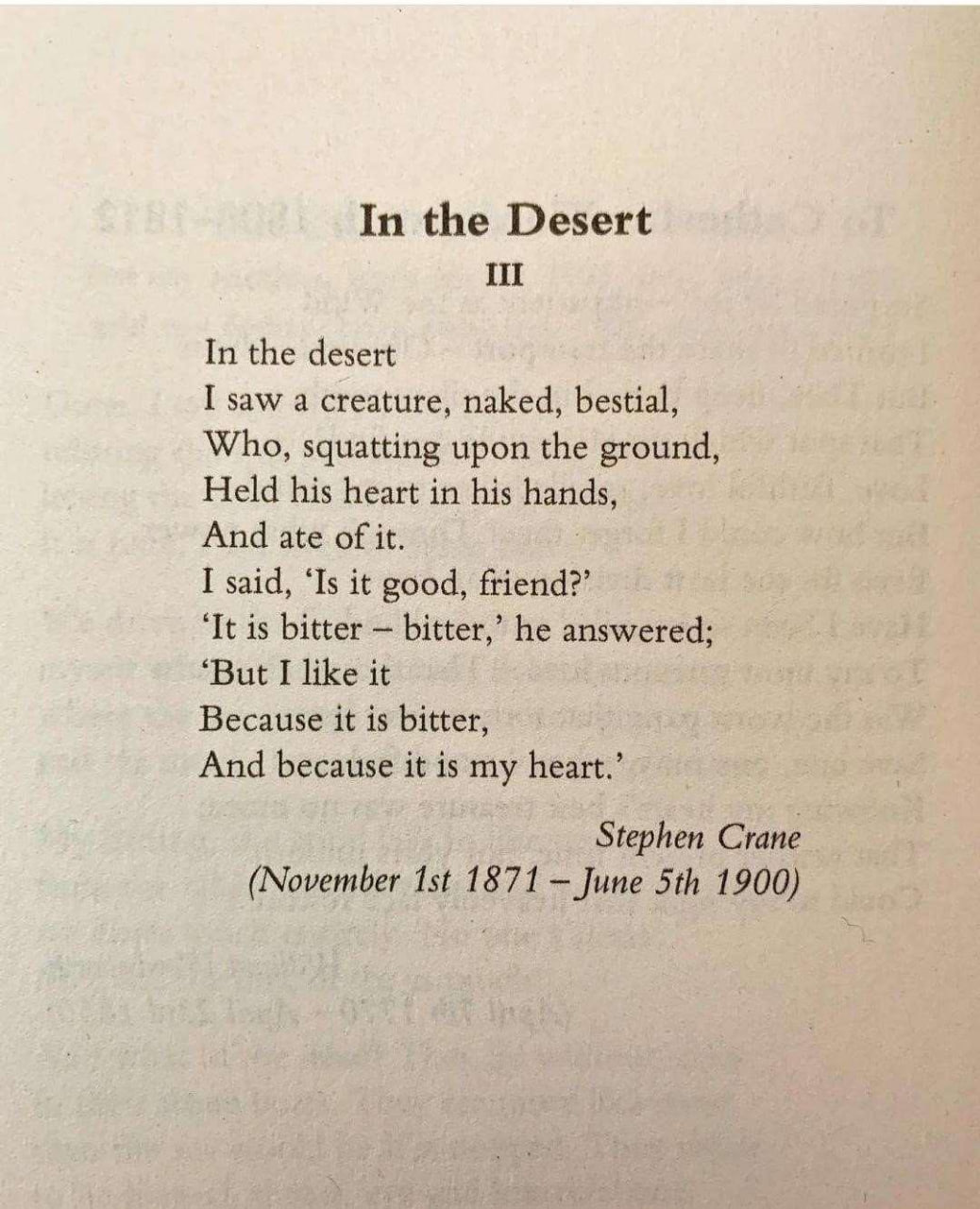
*** by Sylvia Plath
I saw my life branching out before me like the green fig tree in the story. From the tip of every branch, like a fat purple fig, a wonderful future beckoned and winked. One fig was a husband and a happy home and children, and another fig was a famous poet and another fig was a brilliant professor, and another fig was Ee Gee, the amazing editor, and another fig was Europe and Africa and South America, and another fig was Constantin and Socrates and Attila and a pack of other lovers with queer names and offbeat professions, and another fig was an Olympic lady crew champion, and beyond and above these figs were many more figs I couldn’t quite make out. I saw myself sitting in the crotch of this fig tree, starving to death, just because I couldn’t make up my mind which of the figs I would choose. I wanted each and every one of them, but choosing one meant losing all the rest, and, as I sat there, unable to decide, the figs began to wrinkle and go black, and, one by one, they plopped to the ground at my feet.
Иван Сергеевич Тургенев (1818–1883) Из книги «Стихотворения в прозе».
Собака
Нас двое в комнате: собака моя и я. На дворе воет страшная, неистовая буря.
Собака сидит передо мною — и смотрит мне прямо в глаза.
И я тоже гляжу ей в глаза.
Она словно хочет сказать мне что-то. Она немая, она без слов, она сама себя не понимает — но я её понимаю.
Я понимаю, что в это мгновенье и в ней и во мне живёт одно и то же чувство, что между нами нет никакой разницы. Мы тожественны; в каждом из нас горит и светится тот же трепетный огонёк.
Смерть налетит, махнёт на него своим холодным широким крылом…
И конец!
Кто потом разберёт, какой именно в каждом из нас горел огонек?
Нет! это не животное и не человек меняются взглядами…
Это две пары одинаковых глаз устремлены друг на друга.
И в каждой из этих пар, в животном и в человеке — одна и та же жизнь жмётся пугливо к другой.
Февраль, 1878.
My Husband Discovers Poetry by Diane Lockward
Because my husband would not read my poems,
I wrote one about how I did not love him.
In lines of strict iambic pentameter,
I detailed his coldness, his lack of humor.
It felt good to do this.
ㅤ
Stanza by stanza, I grew bolder and bolder.
Towards the end, struck by inspiration,
I wrote about my old boyfriend,
a boy I had not loved enough to marry
but who could make me laugh and laugh.
I wrote about a night years after we parted
when my husband’s coldness drove me from the house
and back to my old boyfriend.
I even included the name of a seedy motel
well-known for hosting quickies.
I have a talent for verisimilitude.
ㅤ
In sensuous images, I described
how my boyfriend and I stripped off our clothes,
got into bed, and kissed and kissed,
then spent half the night telling jokes,
many of them about my husband.
I left the ending deliberately ambiguous,
then hid the poem away
in an old trunk in the basement.
ㅤ
You know how this story ends,
how my husband one day loses something,
goes into the basement,
and rummages through the old trunk,
how he uncovers the hidden poem
and sits down to read it.
ㅤ
But do you hear the strange sounds
that floated up the stairs that day,
the sounds of an animal, its paw caught
in one of those traps with teeth of steel?
Do you see the wounded creature
at the bottom of the stairs,
his shoulders hunched over and shaking,
fist in his mouth and choking back sobs?
It was my husband paying tribute to my art.
Advice to Young Women by Wendy Cope
When you’re a spinster of forty,
You’re reduced to considering bids
From husbands inclined to be naughty
And divorcés obsessed with their kids.
ㅤ
So perhaps you should wed in a hurry,
But that has its drawbacks as well.
The answer? There’s no need to worry -
Whatever you do, life is hell.
Why are your poems so dark? by Linda Pastan
Isn’t the moon dark too,
most of the time?
ㅤ
And doesn’t the white page
seem unfinished
ㅤ
without the dark stain
of alphabets?
ㅤ
When God demanded light,
he didn’t banish darkness.
ㅤ
Instead he invented
ebony and crows
ㅤ
and that small mole
on your left cheekbone.
Or did you mean to ask
“Why are you sad so often?”
ㅤ
Ask the moon.
Ask what it has witnessed.
Whoever said a choir by Rudy Francisco
Whoever said a choir
has to be more than 2 people,
ㅤ
obviously had never been in a car
with my father and me.
ㅤ
When Bob Marley is on the radio,
somehow, we become the same age.
ㅤ
The stereo is loud, but we sing louder.
This is how we safeguard the memory of us,
ㅤ
how we challenge Alzheimer’s to a fist fight,
how we snarl at the disease-
ㅤ
Just to make sure it knows
that we will not go quietly.
Eating Poetry by Mark Strand
Ink runs from the corners of my mouth.
There is no happiness like mine.
I have been eating poetry.
ㅤ
The librarian does not believe what she sees.
Her eyes are sad
and she walks with her hands in her dress.
ㅤ
The poems are gone.
The light is dim.
The dogs are on the basement stairs and coming up.
ㅤ
Their eyeballs roll,
their blond legs burn like brush.
The poor librarian begins to stamp her feet and weep.
ㅤ
She does not understand.
When I get on my knees and lick her hand,
she screams.
ㅤ
I am a new man.
I snarl at her and bark.
I romp with joy in the bookish dark.
Old Man Eating Alone in a Chinese Restaurant by Billy Collins
I am glad I resisted the temptation,
if it was a temptation when I was young,
to write a poem about an old man
eating alone at a corner table in a Chinese restaurant.
ㅤ
I would have gotten it all wrong
thinking: the poor bastard, not a friend in the world
and with only a book for a companion.
He’ll probably pay the bill out of a change purse.
ㅤ
So glad I waited all these decades
to record how hot and sour the hot and sour
soup is here at Chang’s this afternoon
and how cold the Chinese beer in a frosted glass.
ㅤ
And my book—José Saramago’s Blindness
as it turns out—is so absorbing that I look up
from its escalating horrors only
when I am stunned by one of his gleaming sentences.
ㅤ
And I should mention the light
that falls through the big windows this time of day
italicizing everything it touches—
the plates and teapots, the immaculate tablecloths,
ㅤ
as well as the soft brown hair of the waitress
in the white blouse and short black skirt,
the one who is smiling now as she bears a cup of rice
and shredded beef with garlic to my favorite table in the corner.
The plum you’re going to eat next summer by Gayle Brandeis
The plum you’re going to eat next summer
doesn’t exist yet; its potential
lives inside a tree you’ll never see
in an orchard you’ll never see, will be touched
by a certain number of water droplets
before it reaches you, by certain angles
of light, by a finite amount of bugs
and dust motes and hands
you’ll never know. The plum you are
going to eat next summer will gather
sugar, gather mass, will harden
at its center so it can soften toward
your mouth. The plum
you’re going to eat next
summer doesn’t know
you exist. The plum you are
going to eat next summer
is growing just for you.
Sonnet by Billy Collins
All we need is fourteen lines, well, thirteen now,
and after this next one just a dozen
to launch a little ship on love’s storm-tossed seas,
then only ten more left like rows of beans.
How easily it goes unless you get Elizabethan
and insist the iambic bongos must be played
and rhymes positioned at the ends of lines,
one for every station of the Cross.
But hang on here while we make the turn
into the final six where all will be resolved,
where longing and heartache will find an end,
where Laura will tell Petrarch to put down his pen,
take off those crazy medieval tights,
blow out the lights, and come at last to bed.